


NIS2 checklist: What do you need to know?
The NIS2 checklist is your practical guide to navigating the complex landscape of cybersecurity requirements under the new EU directive. It helps organizations understand what steps to take to meet the NIS2 requirements, ensuring that you are not only compliant but also resilient against evolving cyber threats.
The checklist is not a static list of tasks; it is a dynamic tool that adapts to your organization's risk profile, sector, and operational context. By following a structured NIS2 compliance list, you can systematically address governance, technical controls, risk management, and incident response, all while keeping documentation and training up to date.
This approach supports ongoing readiness and helps you prepare for audits or regulatory reviews, making the NIS2 audit checklist an essential part of your security strategy.
1. Orientation and understanding your obligations
Before diving into specific actions, begin with a broad orientation phase. This means understanding the scope of the NIS2 directive as it applies to your organization. The NIS2 readiness guide recommends reviewing the sectors and entity types covered by the directive, as well as any country-specific nuances in implementation.
Some countries require self-registration or notification to authorities before other steps can be taken, so it is crucial to check local requirements and factor these into your NIS2 timeline. During this stage, map out your organization's structure, critical assets, and digital supply chain. Identify which business units, subsidiaries, or partners fall under the directive's scope.
This foundational step ensures that your NIS2 checklist is tailored to your actual exposure and responsibilities, rather than relying on generic templates. Understanding your obligations early will help you avoid gaps that could lead to non-compliance or missed risks down the line.
2. Establishing governance and accountability
A core pillar of the NIS2 compliance list is strong governance. This involves defining clear roles and responsibilities for cybersecurity within your organization. Assign ownership for both IT and OT (operational technology) risks, ensuring that someone at the executive level is accountable for NIS2 compliance.
Document these roles and communicate them across the business. Governance also includes setting up regular reporting lines, escalation procedures, and oversight mechanisms. The NIS2 requirements emphasize board-level awareness and involvement, so ensure that senior management is engaged and receives regular updates on progress and challenges.
Establishing governance is not just about ticking boxes; it is about embedding cybersecurity into your organizational culture and decision-making processes. This will make it easier to demonstrate compliance during a NIS2 audit checklist review and foster a proactive approach to risk management.
3. Risk management and technical controls
Risk management sits at the heart of the NIS2 checklist. Start by conducting a comprehensive assessment of your current cybersecurity posture. Use recognized frameworks or standards to baseline your IT and OT environments, identify vulnerabilities, and evaluate existing controls, including measures aligned with the NIS2 Directive.
The NIS2 requirements call for a risk-based approach, meaning you must prioritize actions based on the likelihood and impact of potential threats. Update or implement technical controls such as network segmentation, access management, encryption, and monitoring tools. Pay special attention to supply chain risks by assessing the security practices of your vendors and partners.
The NIS2 security controls should be documented and regularly reviewed to ensure they remain effective as threats evolve. Remember, compliance is not a one-time event; continuous improvement and adaptation are key to maintaining readiness.
4. Incident response and business continuity planning
A robust incident response plan is a cornerstone of the NIS2 audit checklist. Develop and document procedures for detecting, reporting, and responding to cybersecurity incidents. This includes establishing clear communication channels, escalation paths, and coordination with external stakeholders such as regulators or law enforcement.
Test your incident response plan through tabletop exercises or simulations to ensure everyone knows their role in a crisis. Alongside incident response, create or update your business continuity and disaster recovery plans. These plans should address how to maintain or quickly restore critical operations in the event of a cyber incident.
The NIS2 requirements place a strong emphasis on timely reporting and transparency, so ensure your processes support rapid notification and evidence collection. Regularly review and update these plans to reflect changes in your organization or the threat landscape.

5. Training, awareness, and documentation
No NIS2 readiness guide is complete without a focus on people and documentation. Provide regular cybersecurity training and awareness programs for all employees, tailored to their roles and responsibilities. This helps build a security-conscious culture and reduces the risk of human error leading to incidents.
Training should cover not only technical topics but also policies, procedures, and legal obligations under NIS2. Maintain thorough documentation of all your compliance activities, including risk assessments, control implementations, incident reports, and training records. Good documentation is essential for demonstrating compliance during audits and for learning from past incidents.
It also supports knowledge transfer and continuity as staff or leadership changes over time. By embedding training and documentation into your NIS2 checklist, you ensure that compliance becomes an ongoing, organization-wide effort rather than a periodic scramble before an audit.
NIS2 checklist: Review if you need to comply
The NIS2 directive sets clear boundaries on which organizations must comply, expanding its reach far beyond the original NIS framework. If your organization operates in one of the critical sectors listed in Annex I or Annex II of the directive and meets certain size or turnover thresholds, you are likely within scope.
This includes both public and private entities, with special rules for micro and small businesses in specific cases. Understanding whether you fall under NIS2 is the first step toward building your NIS2 compliance list and preparing for the requirements that follow.
Critical sectors covered by NIS2
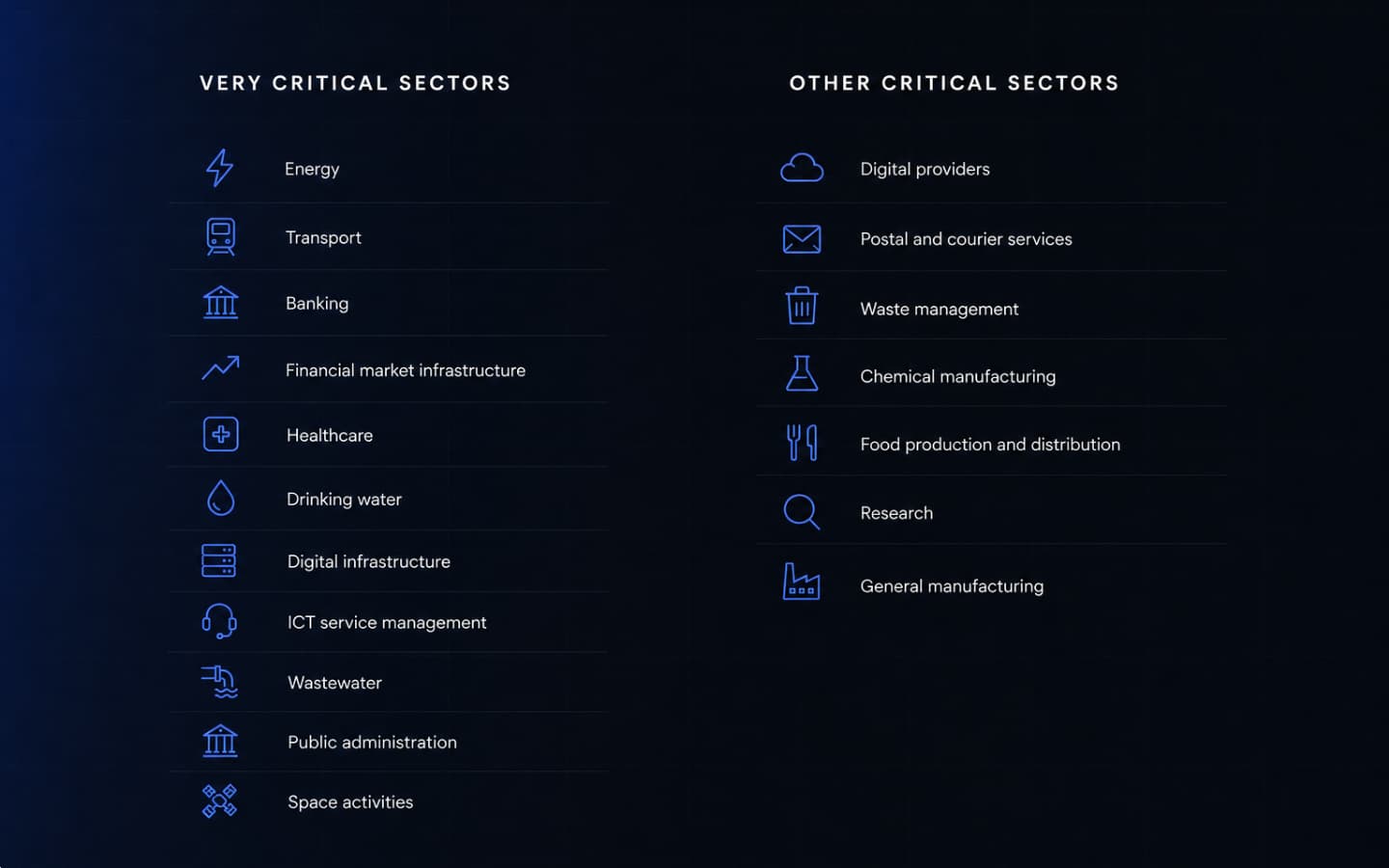
NIS2 targets a wide array of sectors considered vital to the functioning of society and the economy. Annex I of the directive highlights very critical sectors such as energy, transport, banking, healthcare, digital infrastructure, and public administration.
These sectors are seen as essential for daily life and national security, making them a primary focus for NIS2 requirements. Annex II expands the scope to include other important sectors like digital providers, postal and courier services, food production, research, and manufacturing.
If your organization operates in any of these areas, you should immediately consult the NIS2 audit checklist to determine your obligations. The inclusion of both traditional and emerging industries reflects the evolving nature of cybersecurity threats and the need for comprehensive protection across the EU.
Size and significance thresholds for compliance
Not every business in a critical sector is automatically required to comply with NIS2. The directive uses specific criteria based on organizational size and economic impact.
Generally, medium-sized organizations with at least 50 employees or an annual turnover or balance sheet total over €10 million are classified as important entities. Large organizations, defined as having more than 250 employees or a net turnover exceeding €50 million and a balance sheet total above €43 million, are considered essential entities.
Both categories face different levels of scrutiny and obligations under the NIS2 readiness guide. However, there are exceptions: certain micro and small enterprises, such as trust service providers and domain name registries, are included regardless of size due to their critical role in digital infrastructure. Government bodies active in these sectors are also automatically covered.
This tiered approach ensures that the most impactful organizations are prioritized for NIS2 security controls.
Special cases and exemptions
While the directive casts a wide net, there are nuanced rules for micro and small businesses. Most are exempt unless they provide essential digital services or are designated by national authorities as being of vital importance to the economy or society.
For example, a small company providing top-level domain registration may be included, while a similar-sized business in another field might not. National governments have the authority to designate additional entities if their services are deemed crucial.
This flexibility allows for targeted enforcement and ensures that the NIS2 compliance list remains relevant as new threats emerge. Organizations should stay informed about local legislation, as Member States may interpret and implement the directive differently, affecting who must comply and how.
Cross-border and multinational considerations
NIS2's reach extends beyond organizations headquartered in the EU. If your company is based outside the EU but provides critical services within its borders, you may still fall under the directive's scope.
Multinational organizations must assess their status in each Member State where they operate, as local laws and enforcement practices can vary. This adds complexity to the NIS2 audit checklist, requiring careful coordination across jurisdictions.
Supply chain relationships also play a role, as organizations may be considered critical entities if they support essential services indirectly, making supply chain security a key part of NIS2 readiness. The directive encourages collaboration between Member States to ensure consistent application and effective cross-border cybersecurity measures.
For global businesses, understanding these nuances is key to achieving NIS2 readiness and avoiding potential penalties.
How does NIS2 affect your organization?
The NIS2 directive brings a new era of cybersecurity obligations for organizations operating in critical sectors across the EU. Its impact is immediate and far-reaching, requiring not just technical upgrades but also changes to governance, risk management, and operational culture.
For any organization within scope, NIS2 means a shift from reactive security to proactive resilience. The directive's requirements go beyond compliance checklists and demand ongoing vigilance, strategic planning, and a clear understanding of your digital ecosystem. Here is how NIS2 affects your organization in practice.
Governance and leadership accountability
NIS2 places significant emphasis on governance and leadership responsibility. Senior management is no longer able to delegate cybersecurity concerns solely to IT departments. Instead, board members and executives are expected to demonstrate active involvement in cybersecurity oversight.
This includes approving policies, allocating resources, and ensuring that roles and responsibilities are clearly defined throughout the organization. The NIS2 compliance list highlights the need for documented accountability, meaning leaders must be prepared to show evidence of their engagement during a NIS2 audit checklist review.
Personal liability for non-compliance is now a real risk, making it essential for leadership to stay informed and involved in all aspects of cybersecurity strategy and incident response planning.
Operational resilience and risk management
One of the most transformative effects of NIS2 is the requirement to embed operational resilience into daily business processes. Organizations must adopt a risk-based approach to managing threats, which involves continuous assessment and mitigation of vulnerabilities across both IT and OT environments.
The NIS2 readiness guide recommends regular risk assessments, gap analyses, and the implementation of robust controls tailored to the specific risks faced by your sector. This means moving away from static security measures and embracing dynamic processes that evolve with the threat landscape.
Effective risk management under NIS2 also extends to supply chain partners, requiring organizations to assess and monitor the security posture of third parties and ensure contractual obligations reflect NIS2 requirements, including stronger supply chain security expectations.
Incident detection, reporting, and response
NIS2 introduces strict obligations around incident detection, reporting, and response. Organizations must have systems in place to detect cyber incidents quickly and accurately, supported by clear internal escalation procedures.
When an incident occurs, there are tight deadlines for notifying national authorities, often within 24 hours of becoming aware of a significant event. This demands a high level of preparedness, including well-rehearsed incident response plans, staff training, and regular testing of detection capabilities.
The NIS2 audit checklist will scrutinize these processes, so organizations must maintain detailed records of incidents, actions taken, and lessons learned. Failure to comply with these reporting obligations can result in substantial financial penalties and reputational damage.
Continuous improvement and adaptation
Perhaps the most profound impact of NIS2 is its requirement for continuous improvement. Compliance is not a one-time exercise but an ongoing journey.
Organizations must regularly review and update their security controls, policies, and procedures to keep pace with evolving threats and regulatory expectations. This includes staying informed about updates to the NIS2 security controls, participating in sector-specific information sharing, and adapting to new guidance from national and EU authorities.
Regular internal audits, external assessments, and participation in industry forums are all part of maintaining a mature cybersecurity posture.
By embedding continuous improvement into the organizational culture and utilizing the right NIS2 software, businesses can not only meet NIS2 requirements but also build long-term resilience against future cyber risks.